Hi, I’m Anna 💙
I design for people who can't afford confusion: healthcare workers absorbing compliance content between shifts, patients navigating systems that weren't built with them in mind. My work spans information architecture, content strategy, and design strategy. The structure of information is never neutral, and I treat the way content is organized, sequenced, and surfaced as a design decision in its own right. I notice what's unclear, what's been assumed, where someone is going to get lost. I design around those gaps deliberately, and I treat accessibility as structural rather than additive. A design that works but feels unsafe hasn't done its job.
Good design respects the person on the other side of it.

Portrait photo of Anna Babb, 2025.
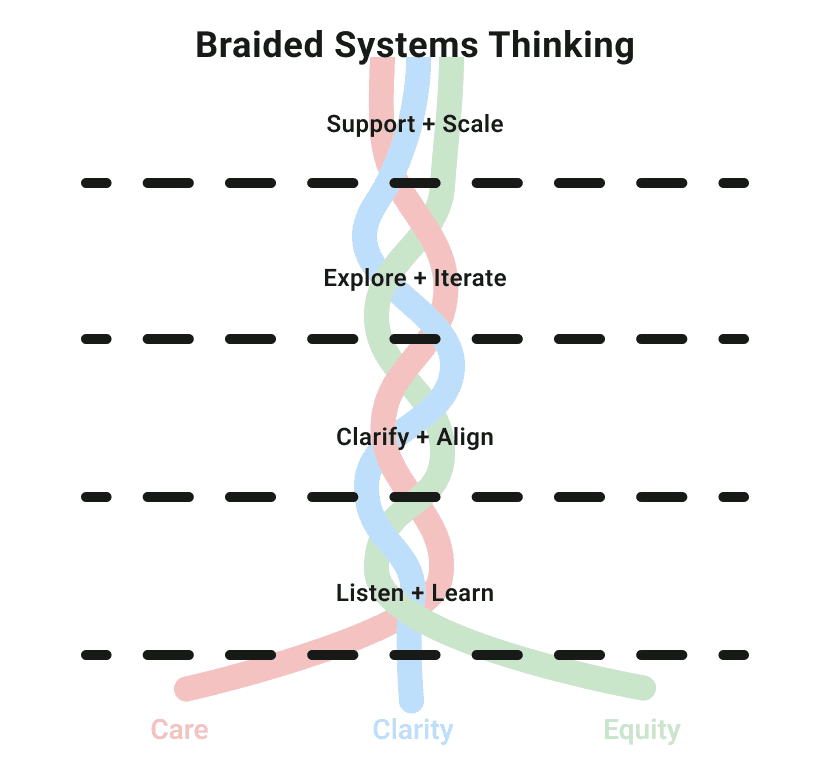
Braided Systems Thinking weaves care, clarity, and equity through each phase of design. The three braid together so that emotional, cognitive, and structural needs are all accounted for.
My Approach: Braided Systems Thinking
Design isn't linear, and neither is the way I approach it. I developed Braided Systems Thinking as a framework to guide my design practice. It weaves together three core values that adapt to every stage of a project:
💗 Care - Emotional and cognitive safety at every touchpoint
🔍 Clarity - Visual and structural logic that makes sense
⚖️ Equity - Systems that flex to meet different needs, not flatten them
These values braid through every phase:
Listen & Learn - Understand users, stakeholders, and systems
Clarify & Align - Define goals and ensure everyone's working from the same map
Explore & Iterate - Prototype, test, and refine with purpose
Support & Scale - Deliver systems that grow with users over time
I combine frameworks like UDL, WCAG, and design systems to fit each challenge, building solutions that feel right and actually work.
Making sense of complexity: I do some of my best work at the stage where everything is still tangled. I find the throughline, organize competing information, and make it coherent enough to actually use.
A natural eye for gaps: I notice what's off. Inconsistencies in content, structural assumptions nobody questioned, places where a user is going to get lost. I catch these things before they become user problems.
Accessibility from the start: Inclusive design decisions are structural to how I work, which means they make the whole thing better, not just more compliant.
Structure before style: I think about structure, hierarchy, and how users build mental models before I think about visual design. The architecture of a thing tells you whether it will work before a single pixel is placed.
Purpose-driven: I do my strongest work when I understand why something matters. Not just the brief but the actual problem underneath it.
Quick Facts & Qualifications
Let's get specific 👇
Bachelor's, Graphic Design @ SCAD 🎨
Master's, Graphic & Experience Design @ NC State 🎓 (thesis on aphantasia, cognitive accessibility, and machine learning-assisted memory tools)
Skilled in WCAG 2.1, Section 508, UDL, and ADDIE-informed instructional frameworks
Co-founded an accessibility-focused ERG at Relias, which grew to 100+ members in its first year
Work spans healthcare, fintech, speculative design, brand systems, and educational technology
Tools: Figma, Framer, Articulate Storyline 360, Rise, Adobe Creative Suite


Lulu, my creative companion, supervising a video chat. Her presence reminds me that thoughtful design comes as much from small moments of comfort and curiosity as from any tool.
Outside of work, you'll probably find me:
Spoiling my cat Lulu, who has strong opinions about my design decisions 🐱
Reading memoirs, speculative fiction, or fantasy - see my Goodreads 📚
Playing cozy, RPG, or strategy games. I care a lot about narrative structures 🎮
Going deep on whatever I'm currently fascinated by: mythology, psychology, video essays. I hyperfixate, which means I tend to know a lot about the things I care about. 🔍